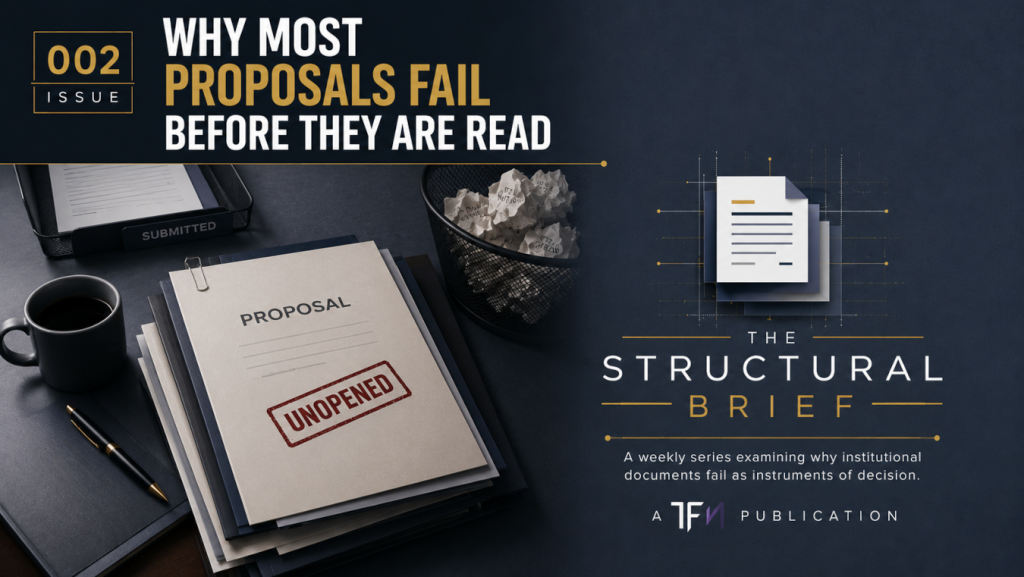
Most unsuccessful proposals are not rejected. They are abandoned long before a decision is made.
Organizations interpret silence as uncertainty, requests for clarification as interest, delayed responses as administrative inconvenience. They keep revising figures, refining language, adding information — believing the proposal is still being considered.
Often, the decision has already been made. Not consciously. Structurally.
A proposal succeeds not by containing more information, but by helping a decision-maker move from uncertainty to confidence. The moment that movement becomes difficult, attention drifts. Once it drifts, recovery is unlikely.
The proposal may still be read. It is no longer leading the decision.
This explains why two documents describing similar opportunities produce different outcomes. One creates momentum. The other creates hesitation. The difference is seldom the idea itself — more often, it is the architecture through which it is presented.
Many proposals are written as records of work completed rather than instruments of decision. Each section may be accurate. Each paragraph well written. Yet the proposal never answers the question quietly occupying the reader's mind: why should this be approved?
When a proposal requires the reader to assemble that basis independently, it has already begun transferring its work to the decision-maker. Few welcome the extra work.
This is why proposals often grow longer as they grow weaker. Every anticipated objection earns another paragraph. Every uncertainty, another explanation.
The document expands. Clarity contracts.
The additional information is frequently correct. It simply arrives before the decision framework has been established. Facts without structural relevance become intellectual weight rather than persuasive force.
The proposal becomes informative. Not decisive.
The opportunity was not necessarily rejected for lacking merit. The document asked the reader to discover it instead of revealing it.
That distinction is subtle. Its consequences are not.
A proposal read carefully and declined has had a fair hearing. A proposal abandoned before a decision is reached never had one.
THE STRUCTURAL BRIEF is a weekly series examining why institutional documents fail as instruments of decision.
— The Frame Mechanic
THE STRUCTURAL BRIEF
A WEEKLY SERIES EXAMINING WHY INSTITUTIONAL DOCUMENTS FAIL AS INSTRUMENTS OF DECISION.
Why Most Proposals Fail Before They Are Read
Most unsuccessful proposals are not rejected. They are abandoned long before a decision is made. Organizations interpret silence as uncertainty, requests for clarification as interest, delayed responses as administrative inconvenience. They keep revising figures, refining language, adding information — believing the proposal is still being considered. Often, the decision has already been made. Not consciously. Structurally. A proposal succeeds not by containing more information, but by he