
Positioning on Parade · Issue 018
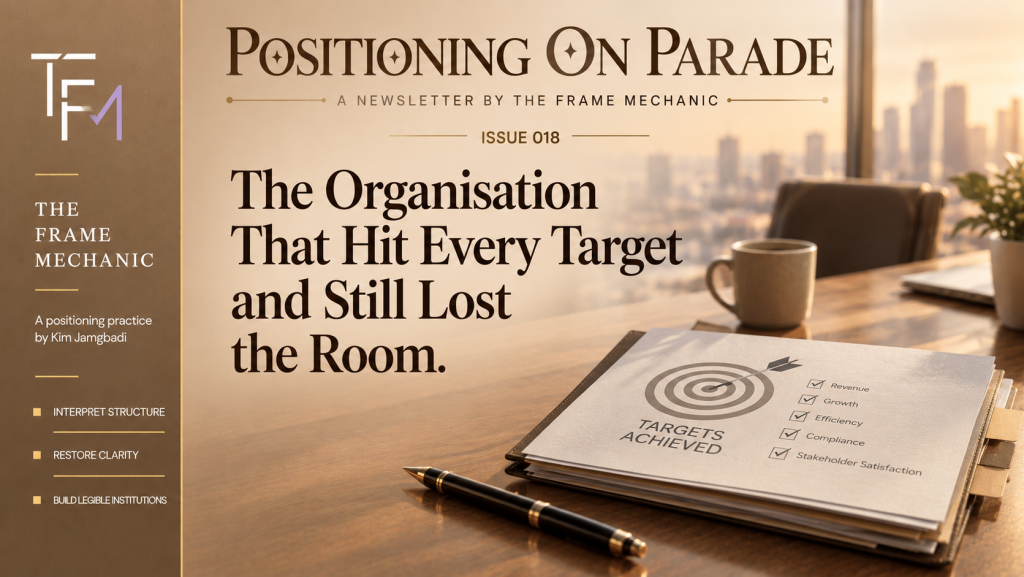
The Organisation That Hit Every Target and Still Lost the Room
Compliance is a record of what was measured. It is not, by itself, a record of what mattered.
Every number the organisation reported that quarter moved in the right direction. Every target set by the framework governing the relationship had been met, most of them comfortably. By any external accounting of the arrangement, this was a successful period — the kind that should have strengthened confidence rather than eroded it.
What actually happened was the opposite. The relationship it was meant to secure grew quietly more strained, for reasons the reporting did not capture and, in a narrow sense, was never designed to capture.
What The Metric Was Standing In For
Every compliance framework exists because measuring the real thing directly is difficult, so a proxy is measured instead. The proxy is chosen because it is observable, reportable, and reasonably correlated with the underlying condition everyone actually cares about. In most periods, for most organisations, the correlation holds well enough that nobody has reason to examine it closely.
The organisation in this case had been offered what the framework required, had accepted it, and had reported the acceptance faithfully. What the framework measured was whether an offer had been made and accepted in volume. What the relationship actually depended on was whether the terms of that offer were ones either side could sustain. These are related questions. They are not the same question, and the gap between them does not show up anywhere in a compliance percentage.
The organisation had satisfied the metric. It had not secured the thing the metric was supposed to be evidence of.
A compliance figure answers the question it was built to answer. It does not announce which questions it was never built to answer — that discovery is left entirely to whoever assumed the two were the same.
Why This Is Not Deception
None of this involved anyone acting in bad faith. The reporting was accurate. The targets were real, and meeting them required genuine effort. The temptation, once the gap becomes visible, is to look for someone who gamed the numbers — and in this case, as in most, there was no one to find.
What had actually happened was narrower and more structural: a proxy that had been reliable for long enough to be trusted without examination had quietly stopped tracking the thing it stood in for, and nobody had been assigned the specific job of noticing when that happened. The metric did not fail. It simply kept measuring what it had always measured, while the condition it was meant to represent moved somewhere else.
How The Room Reads It
Stakeholders rarely announce that they have stopped trusting a compliant organisation. The signal is quieter: a renewal conversation that used to be routine now takes longer. A partner who used to accept the quarterly report at face value starts asking for the underlying detail. A relationship that should be deepening on the strength of a good compliance record instead plateaus, for reasons nobody in the room states directly, because the reason is difficult to state — the numbers are fine, and something is wrong anyway.
This is usually where the organisation’s own instinct fails it. The natural response to eroding trust despite strong metrics is to produce more metrics, report them more frequently, or present them more persuasively. This rarely helps, because the room’s actual concern was never about the volume or clarity of the reporting. It was about whether the reporting still meant what everyone had assumed it meant.
Closing The Gap Between The Number And The Thing
Organisations that catch this early do something specific: they periodically ask what their most-trusted metric would need to be true for it to still be a faithful proxy, rather than assuming that a track record of accuracy in the past guarantees relevance in the present. This is not the same as distrusting the metric. It is checking it — deliberately, on a schedule, particularly for whichever figure the organisation has come to rely on most heavily, since that is the one least likely to have been questioned recently and most likely to have drifted.
The alternative is discovering the gap the way this organisation did: not through the metric itself, which had nothing to report, but through a room that had quietly stopped believing what the metric was supposed to prove.
Hitting every target is evidence that the targets were met. Whether the targets were still measuring what the relationship actually depended on is a separate question, and it is usually asked by the other side first.
A question for this edition: the metric your organisation relies on most heavily to demonstrate that things are going well — when was the last time anyone checked whether it still measures the thing it was built to stand in for?