
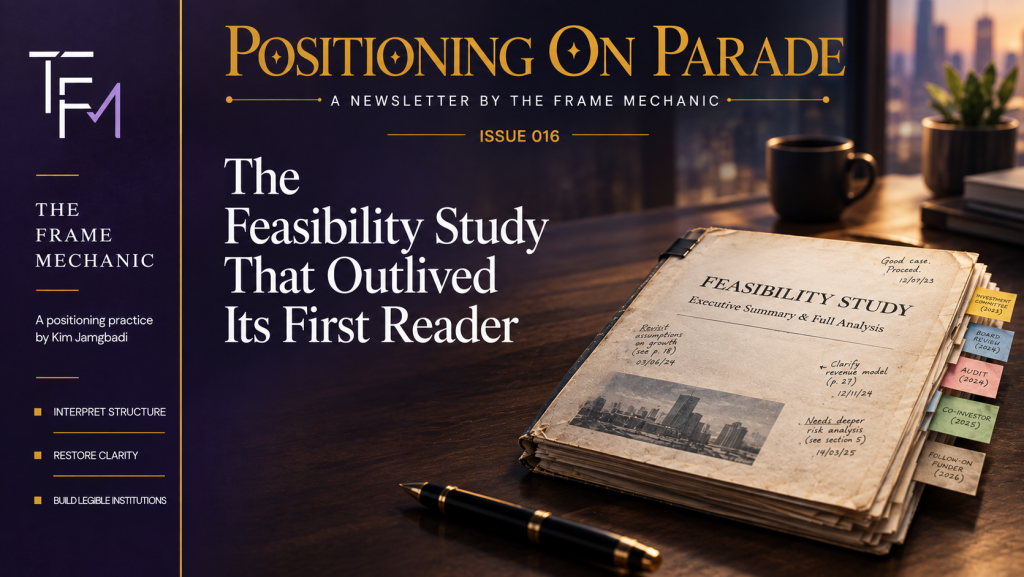
Positioning on Parade · Issue 016
The Feasibility Study That Outlived Its First Reader
A document is written to answer one question, for one reader, at one moment. It rarely stays that contained.
The feasibility study had done exactly what it was built to do. It had persuaded a specific investment committee, at a specific meeting, to say yes to a specific request. The case was strong. The numbers held. The narrative moved from problem to opportunity to return with the kind of confidence that closes rounds. It worked.
What nobody planned for was what happened to the document after it worked.
Who Reads It Next
The first reader wanted to know whether to commit. That reader has been persuaded, has moved on, and will likely never open the document again. But the document does not retire with them. It stays in the data room. It gets attached to the next update. It becomes, without anyone deciding this on purpose, the official record of what the organisation is and why it deserves support.
A co-investor arrives eighteen months later and reads the same pages, asking a different question: not whether to commit, but whether the commitment already made was sound. A board member who joined after the raise reads it looking for the governance logic behind decisions made before they arrived. An auditor reads it as evidence, not argument. A follow-on funder reads it with no memory of the room where it was first presented, no relationship with the person who wrote it, and considerably less patience for a confident tone doing the work that a specific answer should be doing.
Each of these readers is holding the same document. None of them is asking the question it was written to answer.
The founder who commissioned the feasibility study rarely notices this shift happening, because from the inside, nothing appears to change. The document still says what it always said. The confidence is still there on the page. What has changed is invisible from where the founder is standing: the audience has multiplied, and the document was built for an audience of one.
A document written to persuade is optimised to survive one reading, by one reader, under one set of assumptions. Every reading after that is a test the document was never entered into.
What The Second Reading Finds
The gap rarely appears as an obvious lie. It appears as a texture — a confidence in the language that outpaces the certainty in the underlying work, a risk section that resolves too quickly, an assumption stated once and never revisited even as the business changed around it.
None of this was dishonest when it was written. It was persuasive, and persuasive writing is supposed to move quickly past friction. The problem is not that the document argued its case. The problem is that arguing a case and building a record are different disciplines, and the feasibility study was only ever built for the first one.
A co-investor reading for verification notices where the study explained rather than demonstrated. A board member reading for governance notices where a decision is described as made without any account of how or by whom. An auditor reading for compliance notices where a claim outran the evidence directly beneath it. None of these readers concludes that the organisation lied to them. They conclude something quieter and more damaging: that the document in front of them was never built to be checked, only to be believed.
The Cost Nobody Itemises
This rarely shows up as a single dramatic failure. It shows up as friction that gets the wrong name attached to it. A follow-on conversation that should move quickly instead stalls, and the explanation offered is market caution. A board meeting runs long because a decision that should have taken ten minutes to explain takes ninety, and the explanation offered is thoroughness. A relationship with a funder that should be warming with each successful quarter instead cools slightly, for reasons nobody can quite name.
Each explanation is plausible. None of them is the actual cause. The actual cause is a document, still technically accurate, that was never rebuilt for the readers it has since acquired.
What A Document Built To Endure Does Differently
A feasibility study built to survive more than one reading does not sound less confident. It carries a different kind of confidence — one that comes from anticipating the next reader’s specific question rather than simply making the current reader comfortable. It documents not just the conclusion but the reasoning that produced it, so that reasoning can be checked rather than taken on trust. It treats its own assumptions as things that will need to be revisited, and says so, rather than presenting them as settled.
This is more work than writing to persuade one room. It is also the only version of the document that does not quietly expire the moment its first reader stops being the only one who matters.
The document that got you funded is not, by default, the document that will get you through the next three readings. Whether it becomes that document is a decision, not an accident — and it is usually made, or not made, long before anyone asks the question that reveals which one you built.
A question for this edition: the document that made your case the first time — has anyone reread it since, as a stranger would, looking for what it would need to survive being checked rather than believed?