
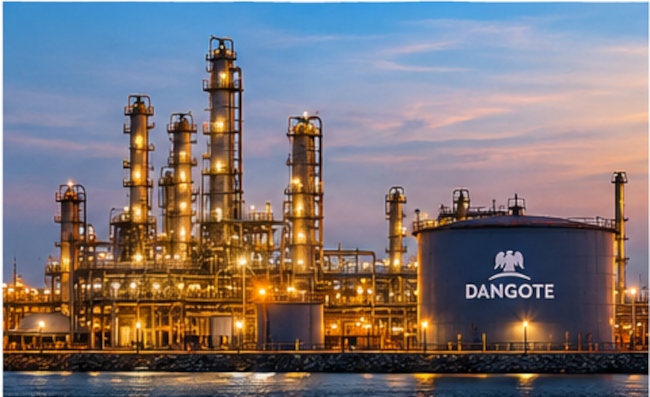
Two things are true about Dangote’s refining ambitions right now, and they are usually reported as two separate stories.
In Nigeria, the Lagos refinery — already Africa’s largest single-train facility, expanded from 650,000 to 700,000 barrels a day after maintenance completed in February — is running well enough to have turned Nigeria from a fuel importer into a genuine seaborne exporter. Product shipments out of the country have grown roughly sevenfold since 2023. A second processing unit, expected to double total capacity again, is already planned for 2028. By the metric most people reach for first — barrels processed, cargoes exported — this is a finished argument. The refinery works.
And yet the second-quarter numbers released by Nigeria’s Upstream Petroleum Regulatory Commission tell a narrower and more interesting story. Domestic producers offered the refinery 68.1 million barrels of crude during the quarter, against a stated requirement of roughly 63 million. On paper, supply exceeded need. What the refinery actually accepted was 52.6 million barrels — seventy-eight percent of what was offered, and short of what it said it required. The regulator’s own compliance figure for the quarter, measuring whether producers met their domestic-supply obligation, came in at 97.4 percent. Nearly everyone did what the rule asked of them. The refinery still didn’t get enough crude on terms it was willing to accept.
Dangote’s own leadership has been fairly direct about what that gap actually is. The company’s Group Vice President for oil and gas said publicly that the central issue was not the volume of crude being made available — it was whether that crude was offered on commercially competitive terms. Enough oil existed. The regulatory box got ticked. The thing the refinery actually needed — crude at a price and on terms that make continuous, full-capacity operation viable — is a different question than the one the compliance percentage was built to answer.
The mechanism behind that compliance figure is worth understanding on its own terms, because it is a genuinely reasonable piece of regulation that still produces an incomplete picture. The Domestic Crude Supply Obligation, enforced under Section 109 of Nigeria’s Petroleum Industry Act, exists precisely because a country that exports crude while importing refined fuel is exporting a problem it could solve at home. The obligation requires domestic producers to offer a share of their output to local refiners before selling into the export market, and the compliance rate measures whether that offer was made. It does not, and was never designed to, measure whether the offer was made on terms a refiner could actually accept at scale. A producer can technically satisfy the rule by offering barrels priced or structured in a way no rational buyer would take in full — compliant on paper, unhelpful in practice. That is not evidence of bad faith on anyone’s part. It is evidence that a rule built to solve an availability problem is being asked to also certify a commercial one, and it was never built to do that second job.
There is a third layer to this pattern worth naming directly, because it stopped being theoretical in April. The World Bank itself recommended that Nigeria reopen fuel import licences, estimating imported petrol could be delivered at roughly ₦1,122 a litre against the ₦1,275 Dangote was charging for locally refined product at the time. Critics inside Nigeria were direct about what that recommendation would do in practice: reopening import channels would increase the country’s exposure to dollar-denominated fuel purchases, add fresh pressure on the naira, and work directly against the Petroleum Industry Act’s own local-refining priority — the same law the domestic crude obligation sits inside. This sits inside a considerably older pattern, documented since the structural-adjustment era of the 1980s and 1990s, in which multilateral lending relationships have tended to reinforce, rather than reduce, African economies’ dependence on dollar-denominated imports — a dependence that keeps debt-servicing arithmetic legible to creditors in ways domestic import-substitution industry can complicate. None of this requires assuming coordinated intent to undermine one specific refinery. It only requires recognising that an institution advising a government toward fiscal stability and an institution building 700,000 barrels a day of import-displacing capacity are not automatically aligned — and that when the advice and the investment case collided openly, as they did in April, it added one more constituency with a real interest in the venture underperforming, sitting alongside the fuel importers and entirely outside anything a compliance percentage was built to measure.
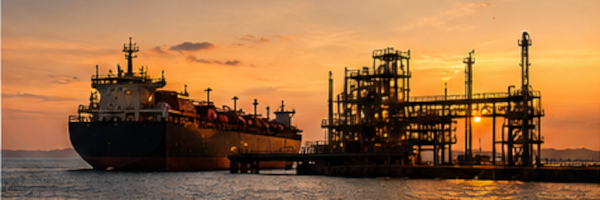
This is not a static situation, either. Dangote has already committed to a second crude distillation unit, expected to roughly double the Lagos refinery’s total capacity by 2028. Every dynamic currently visible in the Q2 numbers — the gap between offered and accepted volumes, the negotiation over commercial terms, an external advisory relationship pulling in the opposite direction — scales with that expansion rather than resolving as the refinery matures. A larger refinery does not need a smaller institutional case around its crude supply. It needs a more resilient one, built before the second unit comes online rather than discovered afterward in the same way the first unit’s gap was.
Meanwhile, roughly four thousand kilometres east, a second and much larger version of the same company’s ambition is meeting a structurally similar problem before it has broken ground.
Dangote has committed to building a $17 billion, 700,000-barrel-a-day refinery on Kenya’s coast — a near-exact replica of the Lagos facility, intended to supply Kenya and its neighbours and reduce East Africa’s near-total dependence on imported refined fuel. The site, at Lamu, was chosen after Tanzania’s Tanga was also considered, in what one regional official described as an international project involving multiple countries rather than a purely Kenyan one. Soil testing and early design work were underway as of the middle of this year, with construction expected to begin before the end of it, financed through a mix of Dangote’s own cash flow, bonds, and a planned public offering.
None of that has stopped the project from running directly into the same category of resistance the Lagos refinery is still managing four years after it opened. Kenya’s president has said publicly that he has discussed with Dangote the scale of opposition the project is attracting from the businesses that currently profit from importing refined fuel into the region — organized, well-resourced pushback from incumbents with every incentive to keep the status quo intact. Separately, environmental groups have raised the absence of a published environmental impact assessment for a coastal site with active mangrove ecosystems and fishing communities, and have asked for the kind of transparent, community-inclusive review process that, as of the most recent reporting, has not yet happened in public view. And Kenya carries its own version of the debt-and-import dynamic already visible in Nigeria: the country is itself operating under IMF-linked lending conditions — a $3.6 billion facility whose associated tax measures triggered public protest — the same broad category of external fiscal relationship that, in Nigeria’s case, produced formal advice pulling against a domestic refining project rather than toward one.
The financing structure adds its own version of the same question. The project is expected to be funded through a mix of Dangote’s internal cash flow, bonds, and an eventual public offering — a structure that, unlike a single-lender project loan, distributes the refinery’s institutional case across a wider set of stakeholders from the outset. Bondholders and future shareholders will be reading the same regulatory and community-relations file that a single bank’s credit committee might otherwise have quietly underwritten. That is not a weakness of the structure. It is simply a wider audience for the same institutional case, arriving earlier than it might have under a more conventional financing model — one more reason the transparency question around the environmental review is not a side issue to the project’s commercial viability, but part of it.
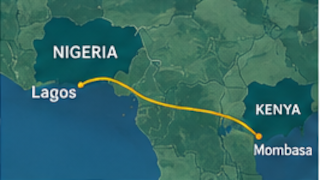
Read individually, these are two unrelated news items: a Nigerian regulatory compliance figure, and a Kenyan infrastructure project facing local opposition. Read together, they are the same structural pattern showing up at two different points in the same company’s timeline.
The pattern is this: the engineering case for a refinery and the institutional case for a refinery are different pieces of work, built on different timelines, and only one of them shows up in the headline number.
The engineering case is barrels per day, capital committed, technology proven, construction schedule. It is the case that gets a project announced, financed, and eventually built. It is also, on the evidence of both Lagos and Lamu, the case that gets the most attention relative to how much risk it actually carries. Building a 700,000-barrel refinery is an extraordinary technical and financial achievement, and both the Nigerian and Kenyan versions of this story confirm that Dangote’s organisation is genuinely capable of it.
The institutional case is a different set of questions entirely, and they are less visible precisely because they don’t produce a single clean number. Who controls the commercial terms under which the refinery’s essential input actually changes hands, and what happens when a regulatory compliance metric and the refinery’s actual operating need point in different directions? Who has a standing financial interest in the project failing to reach full capacity, and how organized and well-resourced is that interest — whether it’s a domestic fuel importer with an obvious stake, or an external lending relationship whose advice, however well-intentioned, happens to cut against the venture? Who has the standing to demand transparency before the first excavation, and has that standing been honoured or merely acknowledged? None of these questions are answered by a barrels-per-day figure, a capital commitment, or a construction timeline. All of them determine, in practice, whether the barrels-per-day figure ever gets reached on the schedule everyone announced.
What makes the comparison genuinely useful — rather than simply two data points loosely connected by one company’s name — is the difference in timing between where each project currently sits.
Nigeria’s version of this pattern is being discovered under real operating pressure, four years into a functioning refinery, by a regulator, a producer community, and a refining company that are all now negotiating the actual terms of a relationship the compliance framework only partially describes. That negotiation is happening with capital already spent, a facility already running below the crude intake its own operators say it needs, and a public compliance figure that, however accurate, tells a more complete story than it appears to.
Kenya’s version of the same pattern is showing up before a single foundation has been poured. The organized resistance from import incumbents is already visible. The transparency gap around environmental review is already being named publicly, by people with genuine standing to name it, while there is still time for the review to actually happen in the open rather than after the fact. Whatever the ultimate outcome — and there is a real, live argument in Kenya right now about whether this project should proceed on the terms currently on the table — the friction is arriving at the cheapest possible point in the project’s life to deal with it: before the money is irreversibly committed, not after.
That is not a small difference. An institutional gap discovered before groundbreaking is a design problem. The same gap discovered after four years of operation is a renegotiation, conducted from a position where one side has already spent the capital and the other side knows it.
The pattern is also unlikely to stay confined to one company. Africa’s refining capacity is projected to grow by roughly 1.2 million barrels a day before the end of the decade, led by Nigeria but joined by projects in Angola and Uganda moving through similar stages of development. Each of those projects will publish its own version of a barrels-per-day headline. Few of them will publish, at the same prominence, an equally clear account of who controls their critical inputs, who stands to lose if they succeed, and who has been given genuine standing to ask hard questions before the concrete is poured. The Lagos-and-Lamu comparison is not a story about one company’s two refineries. It is an early, unusually well-documented look at a pattern the whole continent’s current wave of refining investment is about to repeat, project by project, at exactly the scale where getting the institutional case wrong becomes expensive rather than merely inconvenient.
None of this is an argument about whether either refinery should exist, or whether the Kenyan project specifically should proceed on its current terms — that is a live question for the people with actual standing in it, not a conclusion this piece is positioned to reach. What it does suggest is narrower and more durable: a project’s institutional case — who controls the terms of its critical inputs, who has an organised interest in its failure, who has standing to demand transparency and whether that standing has been genuinely honoured — is not a subplot to the engineering story. It is a parallel structure that has to be built with the same deliberateness as the plant itself, on its own timeline, by people whose job is specifically to examine it rather than assume it will resolve itself once the barrels start flowing.
The refinery was never the hard part. Getting the barrels was.