
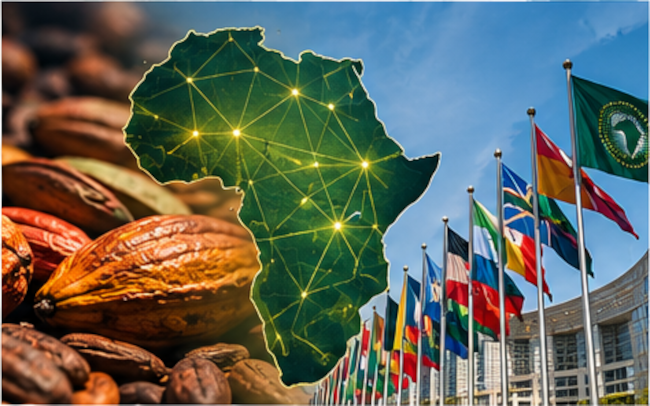
In Abuja this year, at a national summit convened specifically to address it, Nigeria’s president told an audience of cocoa producers and processors that the country would “grind our beans at home” and “sell it to the world on our own terms.” It was a specific policy statement, not a slogan. Cocoa had just contributed more than 643 billion naira to Nigeria’s first-quarter exports — 51 percent of all agricultural export earnings — and the number sitting underneath that achievement was harder to celebrate: Africa produces roughly seventy percent of the world’s cocoa and captures less than ten percent of the value of the global chocolate industry built on it. The beans leave. The grinding, the branding, and the overwhelming majority of the money happen somewhere else.
Nigeria is not moving alone. Ghana’s president announced in February an intention to restrict raw exports of cashew, shea, and rubber, targeting fifty to sixty percent domestic processing under a new Tree Crops Development Authority. Benin got there first and has the results to show for it: a 2024 ban on raw cashew exports has already pushed roughly fifty thousand tonnes into domestic processing that would previously have left the country as raw nuts. Côte d’Ivoire’s transformation is the clearest evidence that this is achievable rather than aspirational — cashew processing capacity there grew from under seventy thousand tonnes in 2015 to three hundred fifty thousand tonnes in 2024, the number of processing plants went from three to roughly forty, and more than eighteen thousand jobs were created, two-thirds of them held by women.
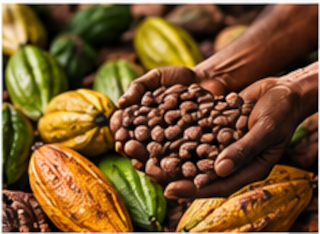
At almost the same moment, a parallel and less commented-on shift has been under way in how African governments engage the rest of the world diplomatically. Analysts increasingly avoid the Cold War term “non-alignment” for what’s happening now, because the posture isn’t ideological neutrality — it’s active, simultaneous engagement with multiple major powers on different terms for different needs. China has been Africa’s largest trading partner for sixteen consecutive years running, with trade exceeding a quarter of a trillion dollars. The African Union secured a permanent seat at the G20 in 2023. Russia’s footprint runs through security and military cooperation, concentrated in the Sahel. The United States and Europe have answered China’s infrastructure diplomacy with their own — a rail corridor through Angola and the Democratic Republic of Congo, backed by a US development-finance loan of more than half a billion dollars, explicitly positioned as a counterweight to Belt and Road projects moving the same minerals through different ports, on different terms, toward different buyers. The stated logic behind engaging all of these powers without formally subordinating to any of them is explicit in the language analysts now use: multi-alignment, not non-alignment. Energy security, infrastructure, technology, and leverage — not ideology.
Read separately, a cocoa policy and a foreign policy posture don’t obviously belong in the same conversation. Read together, they are the same structural move made at two different altitudes: a refusal of a role assigned from outside — raw material supplier in one case, reliable bloc member in the other — in favour of terms set from within.
Both refusals share a second thing, less visible than the policy announcements themselves: they are recent, deliberate, and contested even within Africa. Ghana’s export-restriction announcement arrived alongside warnings from its own processors that domestic capacity isn’t yet built to absorb the volume a ban would redirect — precisely the gap between declaring a policy and having the infrastructure to make it work that the Côte d’Ivoire comparison exists to test. Multi-alignment carries the same internal tension. Continental solidarity on any single geopolitical question routinely gives way to individual national interest when the specific case is close enough to home, and analysts tracking the posture are explicit that divergence, not unity, is the more common outcome once a general principle meets a concrete vote.
There is a reasonable question underneath both moves, and it is worth asking plainly rather than assuming the answer: why would any country accept indefinite dependency on a partner, or a bloc, whose own behaviour toward its closest allies has been this unpredictable?
The evidence for that unpredictability arrived from two different directions this year, and neither required African governments to interpret anything — both played out in public. Washington’s tariff measures did not stop at strategic competitors; they landed on Canada and the European Union, two of the United States’ oldest and most integrated trading partners, triggering a Canadian trade-diversification strategy explicitly built to cut dependency on the US market and a matching scramble across European capitals. And when the United States and Israel launched joint strikes on Iran at the end of February — a strike that killed Iran’s Supreme Leader and set off a regional war still producing casualties as recently as this month — Washington’s own transatlantic allies were not consulted in advance and did not respond as one bloc. The United Kingdom criticised Iran while simultaneously calling for de-escalation and initially restricted American use of its own Diego Garcia base. Germany’s response was, in its own diplomats’ words, measured. Spain’s prime minister was openly critical of both Washington and Israel. The Council on Foreign Relations’ own analysis called the result a “strikingly disjointed European response”; Al Jazeera’s coverage put it more bluntly still: the bloc failed to unite.
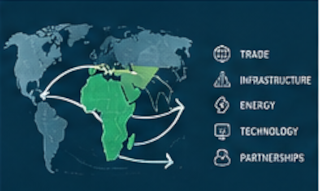
None of this is offered as a verdict on whether the strikes on Iran were justified, or on the tariffs, or on any government’s specific position in either dispute — those are separate, contested questions with serious arguments on more than one side, and this is not the place to adjudicate them. What the two episodes establish, independent of who was right, is narrower and more useful: the bloc a country would be joining by picking a side is not, in either economic or military policy, a single coordinated actor with one voice. It disagrees with itself in public, under real pressure, on questions of real consequence. Treating alignment with it as a stable, unified commitment misreads what is actually on offer.
That observation strengthens the case for multi-alignment. It does not, by itself, make multi-alignment succeed — and this is where the comparison to the cocoa and cashew story becomes genuinely useful rather than merely decorative.
One of the sharper critiques of Africa’s processing push, offered by a commentator watching the cocoa announcements with more scepticism than the summit stage allowed, cuts directly to the point: processing cocoa in Africa is not decolonisation if the farmers growing it remain raw-material suppliers to somebody else’s factory, merely relocated. Ownership, branding, and market power determine who captures value — not which country the grinding happens in. A processing plant built, financed, and eventually owned by the same external interests that used to simply buy the raw beans has changed the location of the activity without changing the structure of who benefits from it.
The geopolitical version of the identical failure mode already has a name in the literature analysts use to describe multi-alignment’s real vulnerabilities. Elite capture — domestic political and economic figures aligning with an external power for personal benefit rather than national advantage — can hollow out a stated foreign policy from the inside, exactly as a cocoa-processing policy can be hollowed out if the ownership of the new plant never actually shifts toward the farmers or the country the policy claims to serve. Analysts also point to active efforts by competing major powers to peel individual African states away from unified continental positions, offering better bilateral terms to whichever government breaks ranks first — the diplomatic equivalent of one buyer picking off individual cocoa-farming cooperatives with slightly better prices, undermining a coordinated pricing position before it can take hold.
And underneath both versions sits the same binding constraint, visible in concrete rather than abstract form in Zambia’s position right now: a country carrying public debt above eighty percent of GDP, rated deep into speculative-grade territory, has measurably less room to hold a policy position — economic or diplomatic — against external pressure than one that doesn’t. Zambia’s own local-procurement quotas on copper and cobalt are a real, stated policy choice in the same family as Nigeria’s cocoa summit and the continent’s multi-alignment posture. Whether that policy survives contact with the next debt-restructuring negotiation, on terms set by whoever is doing the restructuring, is a separate question from whether the policy was announced with conviction. A government does not get to choose how much leverage its balance sheet gives it, regardless of how clearly it states its position at a summit or in a communiqué.
There is a reason the African Union’s Continental Critical Minerals Value Addition Framework and the African Continental Free Trade Area matter as much as any individual country’s cocoa policy or diplomatic statement. A single country restricting raw exports or declining to fully align with one bloc can be outlasted, out-negotiated, or quietly picked off — offered a marginally better bilateral deal in exchange for breaking from a common position, the way a single cocoa cooperative can be offered a slightly better price to undercut a coordinated pricing agreement before it takes hold. A coordinated continental position is considerably harder to dismantle one government at a time. AfCFTA’s underlying logic is explicitly this: fifty-four national markets, negotiating and trading separately, are individually small enough to be managed one at a time by whichever external partner is doing the managing. Treated as a single market of 1.3 billion people, the same fifty-four countries become something closer to what CUSMA gives Canada inside its own dispute with the United States this year — not immunity from pressure, but a structure that makes picking off individual members considerably more expensive than dealing with the bloc as a whole. The cocoa-pricing coordination attempted at the Abuja summit and the AU’s continental minerals framework are both, underneath the announcement, attempts to build that same structure in a different sector.
The renaissance visible in both a cocoa summit and a foreign ministry’s shifting posture is real, and it deserves to be taken at face value rather than dismissed as rhetoric — the tonnage data out of Côte d’Ivoire and the trade figures out of Beijing are not aspirational, they are already booked. But choosing where something happens, or which partners to engage on which terms, is the first decision, not the only one. The second, harder decision — who actually holds the ownership, the leverage, and the standing once the choice has been made, and whether the coordination exists to defend that position when a single government comes under pressure to break from it — is the one that determines whether either renaissance produces a different outcome from the one it was built to replace, or simply relocates the same outcome somewhere that feels better to stand in.