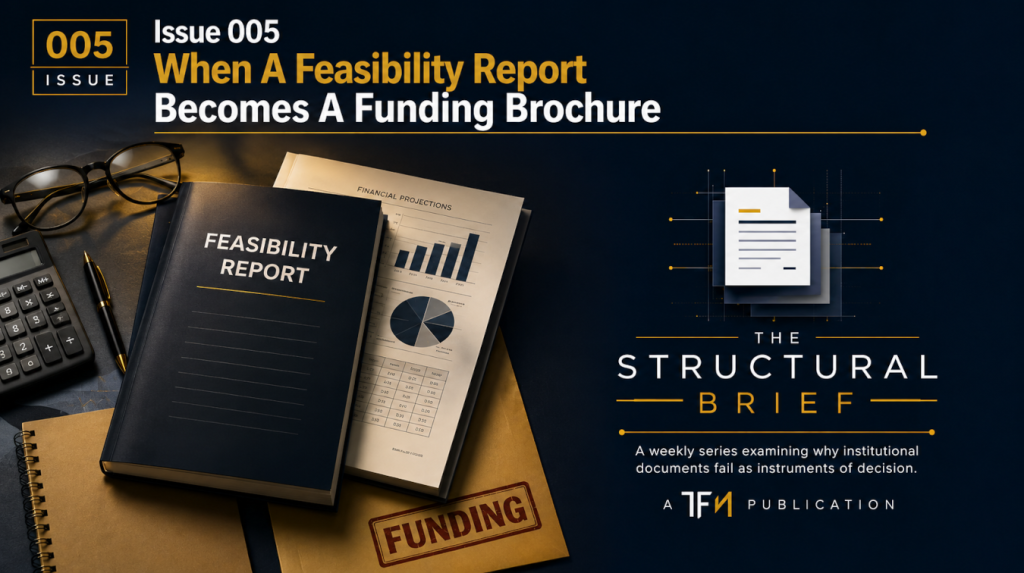
A feasibility report answers: should this project proceed? A funding brochure answers: why should you fund this project?
The distinction appears subtle. It isn't. One protects capital. The other seeks capital. Confusing them alters the document's entire purpose.
Most feasibility reports don't fail because the assumptions are weak or the engineering unsound. They fail because, somewhere during preparation, the document changes allegiance — from serving the decision-maker to serving the project. Every paragraph becomes supportive. Every risk becomes manageable. The report stops investigating feasibility. It begins defending desirability.
This shift shows up first in presentation, not language. Cover pages grow more visual than the content warrants. Favorable figures pull into callout boxes; comparable risk figures sit in dense paragraph text, technically present but visually unremarkable. None of these choices are dishonest individually. Together, they change what the document is asking the reader to do.
A genuine feasibility report can conclude: not yet, not here, not at this scale. A funding brochure cannot afford such conclusions — its purpose is persuasion, not judgment. A report that states its returns prominently and its risks quietly has already chosen which one it wants remembered.
Ironically, this transformation weakens the very objective it seeks. Sophisticated investors don't reject projects because they contain risks. They reject documents that appear unwilling to acknowledge them. Institutional capital expects uncertainty. It distrusts certainty. An executive reading an overly enthusiastic report rarely concludes this project has no weaknesses — more often, this document is concealing something. Trust erodes before due diligence begins.
A feasibility report's credibility is determined less by how convincingly it presents opportunity than by how objectively it evaluates constraint. Its responsibility is not to sell a project. It is to establish whether the project deserves to be sold at all.
THE STRUCTURAL BRIEF is a weekly series examining why institutional documents fail as instruments of decision.
THE STRUCTURAL BRIEF
A WEEKLY SERIES EXAMINING WHY INSTITUTIONAL DOCUMENTS FAIL AS INSTRUMENTS OF DECISION.
When A Feasibility Report Becomes A Funding Brochure
A feasibility report answers: should this project proceed? A funding brochure answers: why should you fund this project? The distinction appears subtle. It isn't. One protects capital. The other seeks capital. Confusing them alters the document's entire purpose. Most feasibility reports don't fail because the assumptions are weak or the engineering unsound. They fail because, somewhere during preparation, the document changes allegiance — from serving the decision-maker to se