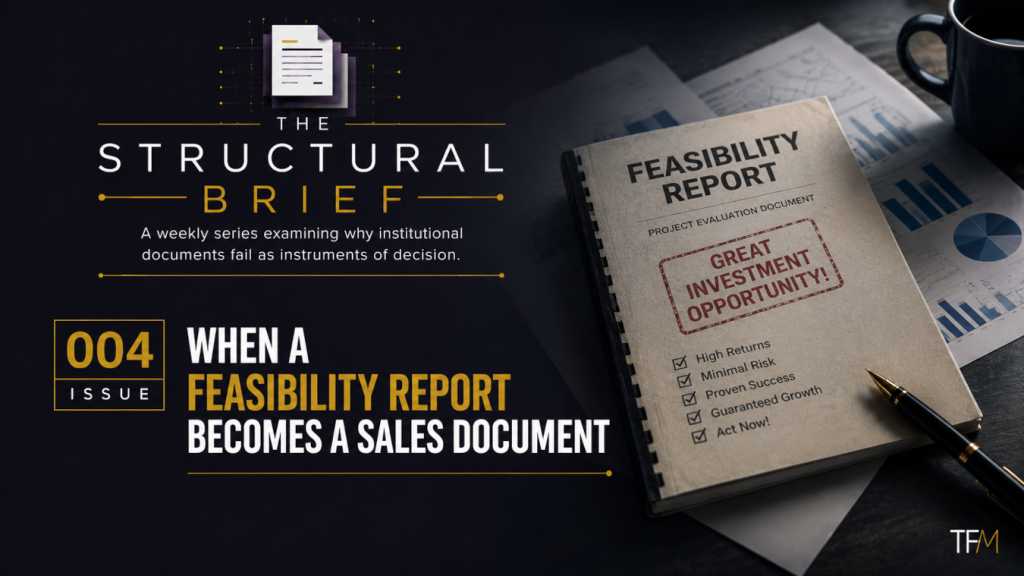
Few documents command as much confidence as a Feasibility Report. Its title suggests objectivity, evidence, reasoned judgment.
Yet in many institutions, something subtle happens before the first page is written. The document quietly changes its purpose.
A feasibility report is expected to answer: should this initiative proceed? Increasingly, many begin from a different position: how do we justify proceeding? The difference appears invisible. Its consequences rarely are.
A report that tests a proposition against reality has value because it is willing to say no. A report that cannot arrive at no has not tested feasibility — it has assumed it, then documented the assumption at length.
The transformation seldom announces itself. Alternatives receive little attention. Risks become manageable inconveniences. Benefits become increasingly certain. By the conclusion, the reader is no longer witnessing an examination. They are reading an argument.
The drift is rarely one decision. The commissioning party already has a preferred outcome. The writer senses this, consciously or not. Uncomfortable findings get framed more gently, one paragraph at a time.
The problem is not advocacy — advocacy has its place. The problem begins when advocacy disguises itself as evaluation. A sophisticated reader notices this less through what the report says than through what it never says: the absence of a sentence reading this could fail, and here is exactly how.
Once a feasibility report becomes a sales document, something valuable is lost. Not simply objectivity. Trust. The document can no longer be relied upon as an independent instrument of judgment — a loss often discovered only when the report is the primary evidence being relied upon.
Organizations ask: does the report support the project? Far less often: did the report genuinely test the project? One seeks reassurance. The other seeks confidence.
The strongest feasibility reports are not those reaching favorable conclusions. They are those whose conclusions remain credible regardless of whether the answer is yes, no, or not yet.
THE STRUCTURAL BRIEF is a weekly series examining why institutional documents fail as instruments of decision.
THE STRUCTURAL BRIEF
A WEEKLY SERIES EXAMINING WHY INSTITUTIONAL DOCUMENTS FAIL AS INSTRUMENTS OF DECISION.
When A Feasibility Report Becomes A Sales Document
Few documents command as much confidence as a Feasibility Report. Its title suggests objectivity, evidence, reasoned judgment. Yet in many institutions, something subtle happens before the first page is written. The document quietly changes its purpose. A feasibility report is expected to answer: should this initiative proceed? Increasingly, many begin from a different position: how do we justify proceeding? The difference appears invisible. Its consequences rarely are. A report that test