The Executive Summary is often the shortest section of a proposal. It is also frequently the most influential.
Many proposals never receive the consideration their authors expect — not because the proposal is weak, but because the first page quietly shaped the reader's expectations before the real conversation began. The proposal is no longer leading the decision. It is trying to recover from a first impression it never realized it had created.
An Executive Summary is often treated as an afterthought, written once the real work is done. That assumption rarely proves harmless. What begins as a summary becomes a compressed description of the pages that follow. Something disappears in the compression — not information, but emphasis. A summary that represents every section proportionally is not summarizing. It is compressing. Compression preserves facts. It does not preserve significance.
Executive Summaries frequently sound alike. They introduce the organization, describe experience, summarize sections, explain methodology. Individually, none of this appears problematic. Collectively, it reveals a recurring failure: the opportunity is present in the document but not in the reader's experience of it — because the summary never distinguished it from everything surrounding it.
Sometimes it arrives late, after paragraphs the reader has already used to form an impression that rarely reverses. Sometimes it arrives diluted, weighted the same as every adjacent fact. Sometimes it arrives only implied, assembled from an accumulation the reader must infer rather than being told directly.
Decision-makers rarely approach a summary with the same expectations as those who write it. One side believes it is introducing a proposal. The other is already forming a decision. A reader asks one implicit question: what am I being given the chance to do here? When the summary cannot answer that in its opening lines, the reader supplies a smaller, vaguer answer than the opportunity actually contained further in.
When a summary fails, the proposal doesn't necessarily fail with it. Meetings still occur. What quietly diminishes is attention — by the time the strongest arguments arrive, the opportunity is already carrying unnecessary weight.
Organizations often ask: does our summary accurately reflect the proposal? A different question is rarely asked: is our summary shaping the decision we expect it to support?
Those questions are not interchangeable.
THE STRUCTURAL BRIEF is a weekly series examining why institutional documents fail as instruments of decision.
THE STRUCTURAL BRIEF
A WEEKLY SERIES EXAMINING WHY INSTITUTIONAL DOCUMENTS FAIL AS INSTRUMENTS OF DECISION.
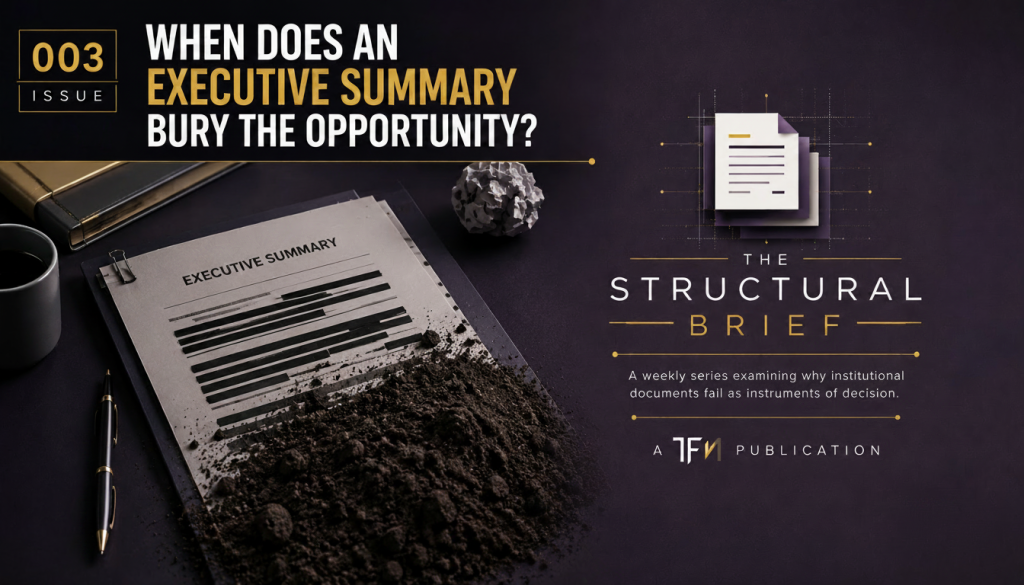
When Does An Executive Summary Bury The Opportunity?
The Executive Summary is often the shortest section of a proposal. It is also frequently the most influential. Many proposals never receive the consideration their authors expect — not because the proposal is weak, but because the first page quietly shaped the reader's expectations before the real conversation began. The proposal is no longer leading the decision. It is trying to recover from a first impression it never realized it had created. An Executive Summary is often treated as