
Most documents contain information.
Far fewer contain a brief.
The distinction sounds minor until one begins to observe how institutions communicate.
A proposal is prepared. A report is submitted. A concept note is circulated. A feasibility study is completed. A presentation is delivered.
The document is comprehensive. The facts are present. The analysis is substantial. The pages are many.
And yet nothing happens.
No decision is made. No approval is granted. No funding is secured. No action follows.
The common explanation is usually that more information is required. It is often the wrong explanation.
The problem is frequently not the absence of information. The problem is the absence of a brief.
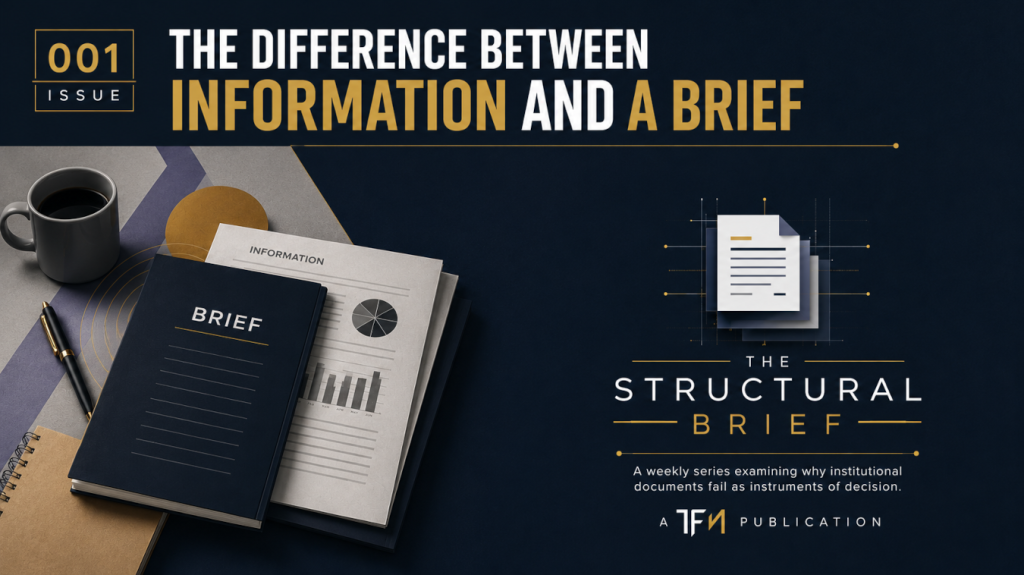
Information seeks to describe. A brief seeks to clarify. Information expands knowledge. A brief reduces uncertainty. Information tells people what exists. A brief helps people determine what should happen next.
This difference is rarely appreciated because most documents are written from the perspective of the author rather than the perspective of the decision-maker.
Authors ask: what do I know?
Decision-makers are asking something entirely different: what am I being asked to decide?
The gap between those two questions is responsible for a remarkable amount of organizational confusion.
A document can contain hundreds of pages of accurate, well-researched information and still fail as a brief. Because information is assembled around a subject. A brief must be assembled around a decision.
One explains. The other directs attention. One accumulates facts. The other organizes relevance. One seeks completeness. The other seeks clarity.
Decision-makers rarely suffer from a shortage of information. More often they suffer from a shortage of clarity. They are not trying to learn everything. They are trying to determine what matters.
This is where many otherwise competent documents begin to fail. The document answers questions. The decision-maker is facing a decision. The two are not necessarily the same thing.
The consequences are rarely immediate. They appear later.
Projects stall. Approvals linger. Meetings multiply. Questions recur. Documents are revised repeatedly. Everyone feels informed. Nobody feels confident.
And confidence, more often than information, is what moves decisions forward.
The distinction between information and a brief is not a writing distinction. It is a structural one. One concerns what is known. The other concerns what can be done.
Confusing the two is where most documents quietly begin to fail.
THE STRUCTURAL BRIEF is a weekly series on why institutional documents fail as instruments of decision.
— The Frame Mechanic
STRUCTURAL BRIEF 002