
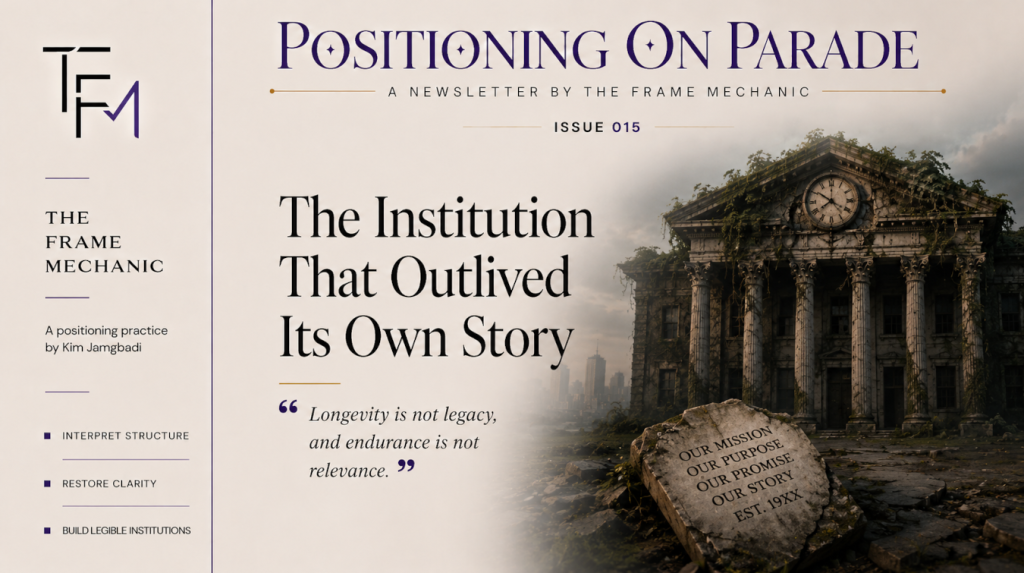
Every institution begins with a story.
Sometimes it is spoken. Sometimes it is never written down. Yet it exists. It explains why the institution came into being, the problem it intended to solve, and the future it hoped to create. For a time, that story gives direction. It shapes decisions. It attracts people. It provides meaning beyond activity.
Then, gradually, something changes.
The institution survives. The story does not.
The offices remain. The staff remain. The meetings continue. The reports are produced. The budgets are approved. The organization appears healthy because its operations continue. What quietly disappears is the narrative that once justified those operations.
Why the Gap Goes Unnoticed
This transition is rarely noticed because institutions are designed to preserve structure. Structures can continue functioning long after the reason for their existence has faded. An organization may continue delivering programs it no longer understands. A business may continue offering products whose original significance has been forgotten.
The people inside experience this least of all. They arrive daily. The work still gets done. Nothing about the internal rhythm signals that the external story has gone stale — daily experience does not feel like decline, even when it is one.
Nothing appears immediately broken. The institution is still busy. But busyness and purpose have never been the same thing.
What the Story Was Actually Doing
Stories perform a structural function. They organize meaning. They help people understand not merely what the institution does, but why its existence still matters. Without that story, continuity slowly becomes repetition. Tradition replaces direction. Maintenance replaces imagination. People begin protecting systems they no longer know how to explain.
This is where many institutions begin mistaking longevity for relevance. They celebrate decades of existence. They recount milestones. They preserve archives. Each achievement may be genuine. None necessarily answers the question that matters most: why should this institution continue to exist?
The question is uncomfortable because it cannot be answered with history alone. History explains survival. Story explains necessity. The two are not interchangeable.
The Compensation
An institution that cannot continually renew its story often compensates by expanding its activity. More programs. More initiatives. More publications. More campaigns. The activity grows. The narrative weakens. Eventually, people encounter the institution without ever encountering the reason behind it.
The organization becomes known. Its significance becomes uncertain.
This is not a communication problem. It is not a branding problem. It is a positioning problem.
History explains survival. Story explains necessity. The two are not interchangeable.
The Specific Danger
An institution that has outlived its story is more vulnerable than one that never had a strong story to begin with, for a counterintuitive reason: it still believes the story is working. The confidence built during the years the story was true persists long after the story itself has stopped explaining anything — and that confidence delays the recognition that anything needs to change.
By the time the gap becomes undeniable, the institution is not merely behind. It is trying to explain itself from a position of visible decline, which is a considerably harder task than doing so from a position of quiet strength.
What Survives
Institutions are not only structures. They are stories embedded in structures. The ones that avoid this fate are not the ones with the strongest founding stories — they are the ones that treat the story as something requiring maintenance, tested periodically against how the world currently describes the problem, rather than assumed to remain true because it once was.
Institutions do not remain relevant because they continue operating. They remain relevant because the story that once gave birth to them continues to illuminate their future. When that story disappears, the institution may continue for many years. It simply continues without the force that once made its existence inevitable.
An institution does not become irrelevant on the day its story stops being accurate. It becomes irrelevant on the day it stops noticing.
A story, once true, does not remain true on its own. It remains true only for as long as someone is still checking.
A question for this edition: what is the founding story your own institution — or your own practice — still tells about itself? Has anyone tested it recently against how the world currently describes the