
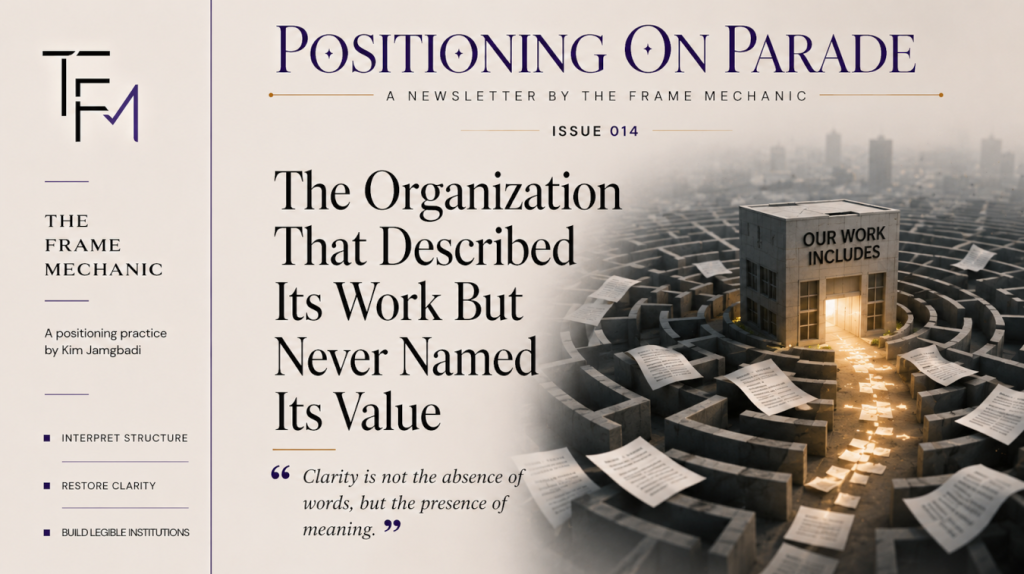
Ask the organization what it does, and the answer arrives quickly, fluently, in well-rehearsed detail. Ask what changes because of it, and something shifts. The fluency disappears. The answer becomes longer, vaguer, more qualified — an account of activity standing in for an account of consequence.
The organization can describe its work with precision. It cannot name its value.
These are not the same capability, and the gap between them is where a specific kind of positioning failure lives — one that is easy to miss because the organization is not silent. It is articulate. It simply keeps answering a question no one asked.
The Substitution
Describing work is safe. It requires no claim about outcomes, no exposure to being wrong, no risk of overpromising. An organization can describe its work in exhaustive, accurate detail without ever staking a position on whether that work matters.
Naming value is exposed. It requires a claim: this changed, because of us, and here is what that change was worth. That claim can be challenged, measured, disputed. It is inherently riskier than description — and organizations that have not resolved what their value actually is will, understandably, retreat to the safer ground of describing what they did instead.
The substitution is rarely conscious. It feels, from the inside, like answering the question. What changed because of your work? becomes What did your work consist of? — and the organization answers the second question fluently, believing it has answered the first.
What the Market Actually Asks
The market does not evaluate organizations on the volume or precision of their activity. It evaluates them on a narrower question: what happens because this organization exists that would not happen otherwise?
An organization that can only answer with a description of process — what it does, how it works, the steps involved — has not answered that question. It has answered an adjacent one, and the adjacency is easy to miss because the description is often genuinely impressive. Sophisticated methodology, extensive experience, careful process. None of it, on its own, names what changed.
Activity describes motion.
Value describes consequence.
An organization can have a great deal of the first and be unable to produce a single sentence of the second.
An organization that can describe everything it does and still cannot say what changes because of it has not yet answered the only question the market is actually asking.
Why This Persists
This failure is difficult to notice internally because the organization is not underperforming by its own account. The work is real. The methodology is sound. The team can speak knowledgeably about every stage of what they do. Nothing about the internal experience of the organization signals a gap.
The gap only becomes visible from outside — in the moment a prospective client, funder, or partner asks the value question directly and receives a process answer instead. The mismatch is not always noticed by the organization delivering the answer. It is noticed, quietly, by the person receiving it, who came looking for a reason to choose this organization over an alternative and left with a description of what a day in its operations looks like.
This is particularly common among organizations built by practitioners who are genuinely excellent at their work. Their fluency about process is earned, not performed — they know exactly how the work happens because they have done it for years. That same fluency, paradoxically, can crowd out the harder, less comfortable exercise of naming what the work is actually worth.
The Cost of Not Naming It
An organization that describes its work but never names its value forces every prospective decision-maker to do that translation themselves — to sit through the description and independently determine what it implies about outcomes. Some will do this work. Most, given the option of a competitor who has already done it for them, will not.
This is also, quietly, a pricing problem. An organization cannot charge for value it has not named, because there is nothing to point to when the fee is questioned. What remains is a fee for activity — for time, for process, for effort — which is precisely the weaker commercial position a different value entirely would have avoided.
The organization that describes its work but never names its value is not lacking in substance. It is often full of it — methodology, experience, process, evidence of diligence. What it lacks is the harder, more exposed act of stating plainly what that substance produces. Description is comfortable because it cannot be wrong. Naming value is uncomfortable because it can be. Most organizations that struggle to be chosen have not failed to build something worth choosing. They have failed to say, in a single clear sentence, what choosing them actually changes.
The test is simple to state and uncomfortable to apply: remove every sentence from your materials that describes what you do, and see what remains. If nothing does, the organization has not yet named its value. It has only described its motion.
What you do is not the same claim as what changes because you did it. The market pays for the second. Most organizations are still only prepared to explain the first.
A question for this edition: if you removed every description of process, methodology, and activity from your own materials, what single sentence about outcomes would be left? If the sentence does not yet exist, that absence is the positioning problem — not the work itself.