
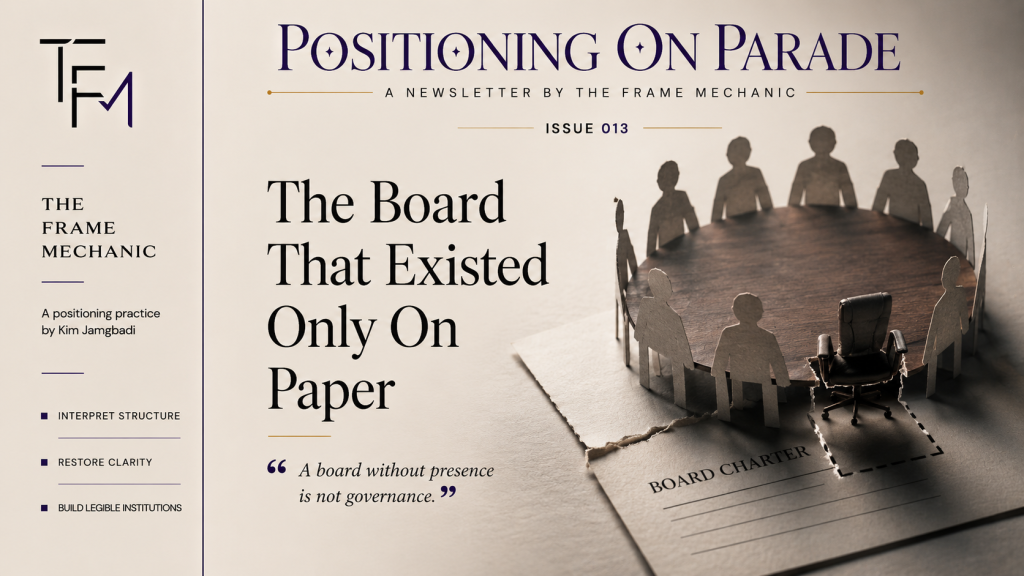
Most organizations have boards. Far fewer are actually governed by them.
There is a difference. One is a legal structure. The other is an operating reality.
The distinction is easy to overlook because boards are often described in terms of their existence rather than their function. An annual report lists the members. A website displays their names. Minutes are filed. Meetings are scheduled. Compliance requirements appear satisfied.
Everything suggests governance.
Yet decisions continue to originate from a single office, a single individual, or a small inner circle. The board receives information after the fact. It ratifies what has already been decided. Questions become formalities. Deliberation becomes ceremony.
The organization possesses a board. The institution does not necessarily possess governance.
Anatomy, Not Behavior
This confusion is more common than many realize because institutions frequently mistake organizational anatomy for organizational capability. They assume that creating a structure automatically creates the behavior the structure was intended to produce.
It rarely does.
A board is not valuable because it exists. It is valuable because it introduces disciplined judgment into institutional decision-making. It creates distance between authority and impulse. It broadens perspective beyond the immediate concerns of management. It protects continuity by ensuring that no single individual’s preferences become indistinguishable from the institution’s interests.
When these functions disappear, the board often remains.
On paper.
This explains why some organizations experience recurring strategic failures despite possessing governance structures that appear entirely adequate. The documents are correct. The appointments have been made. The committees have been established.
The structure exists. Its purpose does not.
How the Drift Occurs
The warning signs are usually subtle rather than dramatic.
Board meetings become occasions for reporting rather than questioning.
Recommendations move through unchanged.
Difficult conversations become increasingly rare.
Directors are selected for familiarity rather than independence.
Agreement is interpreted as effectiveness.
Gradually, governance becomes symbolic. The institution continues to speak of accountability while relying almost entirely on trust. It celebrates oversight without inviting examination. It preserves the appearance of institutional maturity while concentrating practical authority elsewhere.
None of this is necessarily deliberate. It often develops slowly as founders, executives and directors become accustomed to arrangements that seem efficient in the short term. Over time, convenience quietly replaces governance.
The Governance Delusion
A collection of distinguished names is not an institutional asset. It is a directory.
Governance is not defined by who sits on the roster. It is defined by what power that roster holds to redirect, halt, or question the institution’s direction. If a board cannot overrule leadership’s worst instincts, it does not functionally exist — regardless of how it appears on paper.
A board that cannot say no is not a board. It is a mirror — reflecting back whatever management already believed.
When the Consequences Surface
The consequences of a paper board rarely appear immediately. They surface when succession arrives. When conflict emerges. When financial pressure increases. When strategy must change. Or when decisions that should have been examined more carefully can no longer be reversed.
By then, institutions often discover they possessed a board but had never developed the discipline that gives a board its institutional value. Sophisticated observers — investors, regulators, serious institutional partners — do not evaluate governance by attendance records. They ask a narrower question: has this board ever said no to something leadership wanted? An institution that cannot produce an example has revealed something it did not intend to reveal.
The board that exists only on paper is not a failure of individuals. It is a failure of design — a structure that produces the appearance of accountability without the substance of it. The moment real pressure is applied, the paper tears, exposing the ungoverned core beneath.
There is an important distinction between having a governing body and being governed. Confusing the two is where many institutions begin to mistake organizational structure for institutional strength.
A board that only ratifies is not providing oversight. It is providing cover. The two are frequently mistaken for one another until the distinction becomes expensive.
A question for this edition: think of a board or advisory structure you have observed — including your own. Can you name a specific instance where it changed a decision, rather than simply