
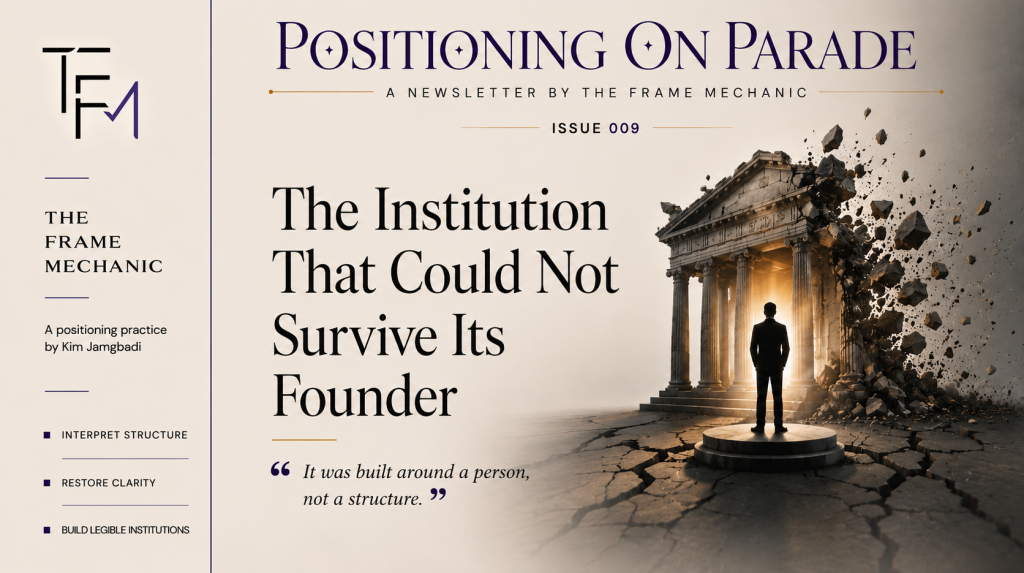
An organization becomes an institution only when it can outlive the person who built it.
Most founders believe they are building the first. Many are building a dependency that wears the same name.
The institution did not close when the founder left. It simply stopped making sense. The staff remained. The programs continued. The name persisted on letterhead, websites, and grant applications. Everything that constitutes operational continuity was present. And yet something had gone that the institution could not name, could not locate, and could not replace — because it had never been built into the institution in the first place.
What The Founder Was Actually Doing
Their presence had been easy to misread. While they remained, the institution appeared to possess what it had never built. It appeared to have a clear identity because the person at its center had a clear identity.
What went unnoticed was that the founder had quietly become the institution’s operating system.
Every important judgment passed through them.
Every significant relationship depended on them.
Every difficult decision waited for them.
Every major opportunity required their presence.
The organization functioned. But only because the founder functioned.
The founder acquired experience. The institution acquired habits.
The founder developed judgment. The institution developed reliance.
The founder became increasingly capable. The institution became increasingly dependent.
This is not usually the result of ego. It is often the result of competence. Capable individuals naturally attract responsibility. They solve problems quickly. They become trusted. Over time, more matters flow toward them, and the institution responds rationally: why develop a process when the person at the top already knows the answer? Why strengthen a system when the issue can be resolved personally? Efficiency gradually replaces institutionalization. The organization becomes faster. But it also becomes more fragile.
The Market’s Reading
Markets calibrate trust through succession. They ask — quietly, without stating it — whether an institution can survive the removal of its central figure. When the answer is no, the inference is structural: what the market was trusting was a personality, not an institution.
This inference operates below the level of conscious evaluation but shapes every subsequent judgment about durability. Funders, clients, partners, and peers begin discounting the organization’s claims — not because the individual who built it lacked capability, but because the entity they built lacked independence.
The institution that has confused the two will not discover the difference until the person around whom the confusion was organized is no longer present. At that point, something specific becomes visible.
What looked like governance was access.
What looked like culture was influence.
What looked like alignment was supervision.
The founder had not merely led the institution. They had quietly become the mechanism through which the institution held itself together.
The institution appeared to have authority because its originator had authority. These are not the same condition. They simply look identical until the person responsible for both is no longer there.
The Structural Confusion
Many institutions mistake their founder’s visibility for institutional positioning. The person speaks at conferences, publishes regularly, commands attention in their field, is requested by name. This produces the same observable outcomes as strong institutional positioning — recognition, inbound interest, credibility by association. But it is not the same thing. It is personal authority operating under an institutional name, and those are architecturally different conditions.
The institution that has confused the two will not discover the difference until the person around whom the confusion was organized is no longer present. The visibility disappears with the individual. The recognition disappears with the individual. The inbound interest disappears. The institution retains its name, its history, and its operational capacity — and finds that none of these are sufficient to generate the level of trust it had assumed it possessed.
The assumption was not unreasonable. It was simply wrong.
What Actually Survives
A genuine institution behaves differently. Its decisions can be understood without the person who originally made them. Its values can be explained without them. Its priorities can survive them. Its standards can outlive them.
Growth demonstrates capability. Continuity demonstrates structure. Many organizations prepare for expansion. Far fewer prepare for absence. Yet absence is the more revealing event — the only one that shows whether the institution actually exists independently of the individual at its center.
The question that matters is not: how important am I to this organization? It is: what stops working when I am no longer here? The answer reveals the difference between leadership and dependency, and most founders who ask it honestly find the answer more uncomfortable than they expected.
What survives a departure is what was built into the institution rather than performed by the person who built it. Documented thinking that exists independently of whoever currently holds the title. Positioning clarity that can be articulated by anyone who works there. Relationships that belong to the role rather than the individual who fills it. A reputation for a specific kind of work that precedes any individual’s name.
Most institutions discover this distinction too late — after the departure rather than before it.
The institution that could not survive its founder was not betrayed by the departure. It was betrayed by the assumption that the founder’s authority and the institution’s authority were the same asset. They were not. One was personal, earned by a specific individual through a specific accumulation of observed judgment. The other needed to be built into the entity itself — its positioning, its documented thinking, its named value, its reputation for a distinct kind of work. That construction is not automatic. It does not happen because a capable person is present. It happens because someone decided it was necessary.
Founders often imagine survival as scale. Yet survival is succession. The organization that grows without building what would remain after the founder is gone is not growing toward durability. It is growing toward a more impressive version of the same fragility.
Indispensability is not a leadership trait. It is a structural vulnerability. An institution whose authority cannot outlive its founder never had institutional authority. It had a founder.
A question for this edition: if you stepped away from your organization tomorrow, what would disappear first — the founder, or the structure that depends on them?