
There was a time when executive biographies served a relatively clear purpose. They helped people understand who someone was, what they had done, and why their experience mattered in a specific context.
Today, many executive bios appear to be attempting something different. They are no longer written primarily for interpretation. They are increasingly written for discovery.
At first glance this may not appear problematic. Visibility matters. Searchability matters. In a world of crowded platforms, being discoverable is not a trivial concern. Yet somewhere in the process, many executives have begun solving the wrong problem — and the document that was supposed to establish authority has quietly become a liability to it.
The reader who arrives at a bio has, in most cases, already found the executive. The search has succeeded. The discovery problem has been solved. What remains is an entirely different challenge: the reader is now trying to make sense of what they found. They are forming an impression, deciding in seconds whether this person is worth understanding more deeply.
That is not a search problem. It is an authority problem. And search logic is the wrong architecture for it.
The Wrong Architecture
Search and trust often occupy the same digital space. They appear side by side on the same profile, the same website, the same executive page. Yet they perform fundamentally different functions and reward fundamentally different approaches.
Search systems reward breadth — more categories, more competencies, more discoverable phrases, maximum coverage. Trust systems reward focus — clear thinking, recognizable judgment, interpretive precision, the confident narrowing that signals the practitioner knows exactly which territory belongs to them.
In architecture, a building optimized purely for facade appeal will fail under structural load if the foundational framing is weak. The SEO-optimized executive bio is facade engineering. It looks dense with capability. It lacks load-bearing narrative logic. It was designed to be indexed, not interrogated — and the reader who arrives to interrogate it finds the structure hollow beneath the surface.
Discovery is necessary. Differentiation is decisive. The bio optimized for discovery solves the right problem for the wrong stage — providing search signals to a reader who no longer needs them, at precisely the moment when a different kind of signal is required.
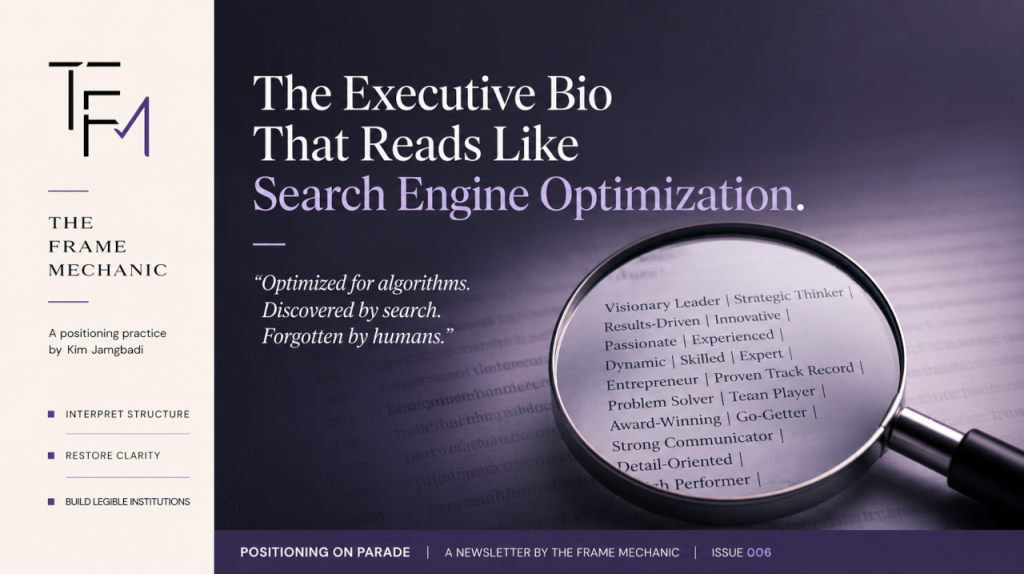
Instead of helping readers understand how an executive thinks, what kinds of problems they solve, or what perspective they bring to complexity, many bios now resemble carefully assembled collections of keywords. Founder. Strategist. Investor. Advisor. Thought Leader. Ecosystem Builder. Innovation Architect. Public Speaker. Board Member. Transformation Expert.
Individually, these labels may be accurate. Together, they produce an unexpected outcome. Rather than strengthening authority, they dilute it. The problem is not exaggeration but accumulation.
What Readers Are Actually Evaluating
People do not evaluate authority by counting credentials. They evaluate it by forming an impression — trying to answer questions that are often subconscious but remarkably consistent.
What does this person actually understand, and what kind of judgment do they possess? What would they see that others might miss? What actually happens when things become complicated and the answers are not obvious?
A bio overloaded with categories and competencies frequently leaves those questions unanswered. Information is transferred, but interpretation becomes difficult. The reader receives a list dressed as a biography. This is why some of the most impressive executive profiles feel strangely forgettable. They tell us everything and reveal very little.
The psychology behind this pattern is worth examining. The person who builds an SEO bio is not careless. They are assembling proof — constructing a case for competence through the accumulation of credentials, titles, and achievements. Each element represents something real. The problem is the assembling impulse itself: the belief that authority is constituted by the quantity of credible signals present in a document.
This belief produces a specific structural signature. The executive who lists twelve distinct authority claims in two sentences has not communicated authority. They have communicated the anxiety of authority. The credential accumulation is the structural signal of a person who does not trust a single one of those credentials to stand alone and carry the full weight of the impression they need to make.
Authority is not strengthened when language touches everything. Authority strengthens when language reveals accurate boundaries. The executive bio that claims ten territories occupies none of them with the precision that makes a territory worth claiming.
The Competitive Cost of Identical Language
There is a further structural cost to the SEO bio that is less commonly examined. When every executive in a given sector optimizes for the same search terms, every bio in that sector begins to read identically. The language converges around the same verbs, the same descriptors, the same strategic stacking of the same credentials.
High search visibility is achieved at the exact cost of institutional differentiation. The executive who built the bio to stand out has made themselves indistinguishable from their entire competitive field. The optimization worked precisely as designed — and that is the problem. The strongest executive biographies achieve the opposite. They select. They prioritize. They direct attention. In doing so they achieve something more valuable than comprehensiveness. They become understandable.
That may sound like a modest achievement. It is not. In an environment saturated with information and indistinguishable professional language, being specifically understandable is increasingly a structural advantage. It allows trust to form more quickly. It reduces interpretive effort. It creates the confidence that a competitor’s bio, however impressively assembled, consistently fails to create.
The Institutional Cascade
The executive bio problem rarely stays contained to the bio itself. It signals something about the institution it represents — specifically, how that institution has learned to communicate with the world it operates in.
Executives who communicate through accumulation tend to produce institutions that also communicate through accumulation: more initiatives, more narratives, more frameworks, more positioning layers, more signals. The linguistic habit of the leader becomes the organizational habit of the institution. Teams inherit the communication architecture of leadership — not through explicit instruction, but through repeated exposure to a pattern of how authority is performed.
This is one reason some scaling institutions feel strangely hollow despite appearing highly polished. Their language architecture has been optimized for impression rather than interpretability. They sound expansive. They are, in practice, structurally illegible — to their own teams, to their partners, and to the markets they are trying to influence.
An executive bio is not primarily a professional summary. It is an authority document — and authority documents succeed or fail according to different rules than search documents. The most diagnostic signal is this: the more language an institution requires to explain itself, the more likely it is compensating for something unresolved beneath the surface. Structural clarity does not expand to fill available space. It compresses. The bio that requires three paragraphs to establish a single impression has not built a richer identity. It has obscured the one it had.
The algorithm will never sign a check, allocate capital, approve a partnership, or decide whom to trust with complexity. Only humans do that. And the humans who make those decisions are not counting keywords. They are forming impressions — trying to determine whether the person in front of them can be trusted to navigate uncertainty with the specific judgment their specific problem requires.
Discoverability attracts attention. Interpretive clarity is what allows authority to survive contact with reality. The executive bio built for the former will consistently underperform at the precise moment the latter is what the decision requires.
The most expensive word in any executive bio is the one that replaced the sentence that would have made the right reader stop.
Search rewards breadth. Trust rewards focus.
Have you ever encountered an executive bio that made you trust the person more — and if so, what exactly did it do differently? The answers tend to be more revealing than the bios themselves.